ASB Energy Pty Ltd has installed a containerised commercial and industrial solar-plus-storage system in Boksburg, Gauteng, for a site that combines AdBlue/Diesel Exhaust Fluid (DEF) manufacturing with a diesel depot.
The installed plant comprises of 615 W Trina Solar modules, 50kW Sunsynk three-phase high-voltage hybrid inverters and BSLBATT HV Pack 8 high-voltage battery systems. Lastly, a Cummins diesel generator controlled by a ComAp InteliLite NT controller remains part of the site’s energy architecture.
1. Application Context & Energy Requirements
Manufacturing AdBlue is an energy-intensive industrial process sensitive to power quality and interruptions. Commercial DEF production relies on multi-stage infrastructure:
- Water Treatment: High-pressure reverse osmosis (RO) or deionisation units.
- Process Machinery: Industrial agitators, temperature-controlled dissolution tanks, filtration pumps, and continuous concentration instrumentation.
- Logistics: PLC-controlled automated transfer systems and high-flow tanker-loading pumps.
This load profile combines sustained motor draws with high-inrush inductive steps (pumps, mixers) and continuous electronic base loads (PLCs, sensors, security).
The adjacent diesel depot adds secondary intermittent pump loads. Operating these inductive and variable loads on a generator during grid outages introduces voltage and frequency stability risks. Integrating hybrid solar-plus-storage buffers load spikes, reduces expensive diesel run-hours, and captures otherwise curtailed solar yield.
2. System Architecture & Component Specifications
| Equipment | Installed Quantity | Hardware Rating | Engineering Significance |
| Trina Solar PV | 192 × 615W | 118.08kWp | Primary daytime generation |
| Sunsynk HV Inverter | 2 × 50kW | 100kW AC | Parallel power conversion, MPPT tracking, battery/grid/gen management |
| BSLBATT Storage | 2 × 78kWh | 156kWh nominal | High-voltage LiFePO4 battery storage (ESS-BATT RE8) |
| Cummins Generator | 1 Unit | Unspecified kW/kVA | Secondary emergency backup & long-duration dispatch |
| ComAp InteliLite NT | 1 Controller | MRS 4 Series | Genset start/stop logic, engine protection, and GCB control |
Inverter & Battery Voltage Matching
Each BSLBATT Pack 8 system consists of eight 9.75kWh LiFePO4 modules rated at 76.8 V / 127Ah.
- Battery Operating Parameters: Nominal voltage of 614.4V sweeping across a 537.6–672V DC range, cooled naturally, with an IP20 protection rating, and >6,000 cycles at 80% DoD (25 °C).
- Inverter Operating Parameters: The Sunsynk 50 kW (SG01HP3-EU-BM4) features a wide 160–800V, battery input range although with a 50A + 50A max charge/discharge current, a nominal voltage of over 500V is more suitable. 4 MPPTs per device allow a 130 kW max combined PV input for the parallel site.
Parallel Topology Requirements
Sunsynk manufacturer guidelines for parallel high-voltage hybrid inverters require each inverter to interface with its own dedicated HV battery stack, rather than tying multiple inverters to a common HV DC bus. The Boksburg plant strictly adheres to this 1:1 topology (one RE8 78 kWh pack per 50 kW inverter), preserving isolated CAN-bus BMS communication and preventing unmanaged cross-currents between HV strings.
DC/AC Ratio & Array Sizing
The 118.08 kWp array against 100 kW inverter capacity yields a DC/AC ratio of 1.18. Distributed across both inverters, each unit sees ~59.04 kWp—well within its 65 kW maximum individual DC input limit.
3. Electrical Performance & Battery Autonomy Analysis
At nominal voltage (614.4V), a 50kW AC discharge through an inverter operating at ~97.6% efficiency draws approximately 83.3A DC. At the battery’s lower voltage limit (537.6V), current draw increases to 95.2A DC across the split terminals.
Both operating points fall within:
- The Sunsynk inverter’s maximum combined battery input rating of 100A.
- The project battery spec’s 127A maximum discharge capability.
Deliverable Storage & Autonomy Runtimes
At an 80% Depth of Discharge (DoD), the 156kWh nominal bank provides 124.8kWh of usable DC energy. Factoring in a 92% round-trip conversion efficiency (DC-to-AC, including cable and thermal losses), the system yields ~114.8kWh of usable AC energy.
| Sustained AC Load | Estimated AC Autonomy (80% DoD) | Operating Context |
| 25kW | ~4.6 Hours | Critical base load (PLCs, controls, RO standby, depot lighting) |
| 50kW | ~2.3 Hours | Single inverter capacity (Moderate fluid mixing & transfer) |
| 75kW | ~1.5 Hours | High production demand (Full processing & water treatment) |
| 100kW | ~1.15 Hours | Maximum rated plant output |
Actual runtime depends on dynamic SOC reserves, ambient container temperatures, BMS current limits, and motor-starting transients.
4. Extended Warranty & Commercial Benefits
The BSLBATT/Sunsynk combination also carries a warranty advantage. Pairing a BSLBATT battery with a Sunsynk inverter automatically qualifies the Sunsynk inverter for an additional five-year warranty extension, increasing the inverter warranty from five years to ten years under the applicable programme.
To maintain compliance, installers must:
- Complete serial-number registration on the Sunsynk online portal.
- Submit a valid South African Certificate of Compliance (CoC).
- Maintain exact BMS-to-inverter CAN communication parameters.
5. Control Strategy, Protection & Generator Integration
The site uses a ComAp InteliLite NT MRS 4 module for single-genset management (remote start/stop, GCB control, J1939 engine monitoring, and safety shutdowns). Because the MRS series is a manual/remote-start unit rather than an Automatic Mains Failure (AMF) synchronising controller, the system relies on an external dry-contact trigger from the Sunsynk inverters or central EMS.
1. Grid Disruption Detected:
Instantaneous islanding.
Sunsynk inverters isolate from the grid and pick up the critical AC bus via battery storage without interruption.
2. Battery Depletion Threshold:
Configured SOC triggers start signal.
When battery SOC drops below pre-set limits (e.g., 20% SOC), the Sunsynk dry contact signals the ComAp InteliLite NT controller to initiate Cummins genset crank.
3. Genset Warm-up & Verification:
Voltage and frequency stabilisation.
ComAp verifies engine speed, oil pressure, voltage, and frequency before closing the Generator Circuit Breaker (GCB).
4. Generator Load & Charging:
Power factor & step-load compliance.
Sunsynk accepts AC generator power, supplying live plant loads while ramping battery charging current within safe generator kW/kVA limits.
Protection Coordination & Commissioning Protocol
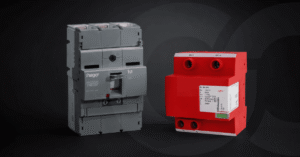
Overcurrent & Isolators: DC fuses must be rated for at least 750V DC with an interrupting rating matching the system fault level. Sunsynk specifies a 120A fuse per 50kW HV unit.
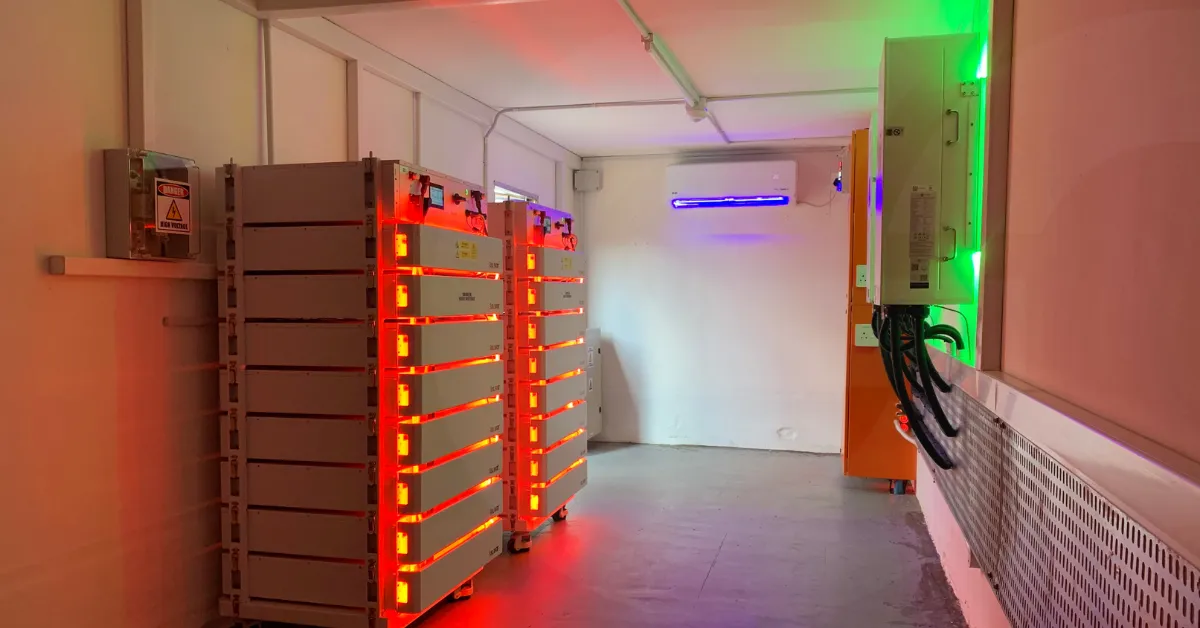
Container Environment: The IP20-rated BSLBATT modules require a climate-controlled enclosure. Intelligent HVAC units prevent internal temperatures from exceeding 25–30 °C, avoiding thermal derating on the naturally cooled batteries and forced-air-cooled inverters.
Commissioning Checklist:
- Verify string VoC and polarity against cold-weather VoC calculations before connecting to MPPTs.
- Confirm isolated battery stack voltages match before closing individual HV isolators.
- Confirm exact CAN-bus protocol selection (BSLBATT / Sunsynk HV) on both BMS and inverter firmware.
- Perform thermal imaging under 100% load on all DC terminals, busbars, and AC breakers.
ASB Energy’s Signature Finish
ASB Energy installations have a distinctive visual appeal. Inside the Boksburg equipment container, multi-coloured, motion-sensor LED lighting illuminates the Sunsynk inverters and BSLBATT high-voltage battery racks, giving the installation a striking, professional finish. But the lighting is more than a showpiece. ASB Energy has incorporated it into the layout to improve serviceability, equipment identification and fault finding.
Inside the distribution board (DB), LED lighting colour-codes the grid, generator and load sections. This gives technicians an immediate visual reference when tracing circuits, inspecting connections or investigating an alarm. In a commercial and industrial installation with multiple power sources, clear identification can save valuable time during maintenance.
Another considered detail is the placement of phase-presence indicator lights through the metal DB door. The wiring and electrical connections remain protected inside the enclosure, while the indicator lenses are visible from outside. Operators can therefore check the indicated presence of voltage on each phase at a glance, without opening the panel. These indicators provide a useful preliminary check, although they do not replace electrical testing or confirm phase rotation and power quality.
The installation has also been planned with future expansion in mind. The customer is considering additional capacity as production requirements grow. BSLBATT’s modular high-voltage battery platform and Sunsynk’s parallel-inverter architecture offer potential expansion options, subject to equipment compatibility, available PV input capacity and system design limits.
Any expansion should be based on measured load demand, battery performance and the manufacturer’s approved battery-to-inverter configuration. For ASB Energy, attention to detail extends beyond how the installation looks today to how efficiently it can be maintained and developed in the years ahead.