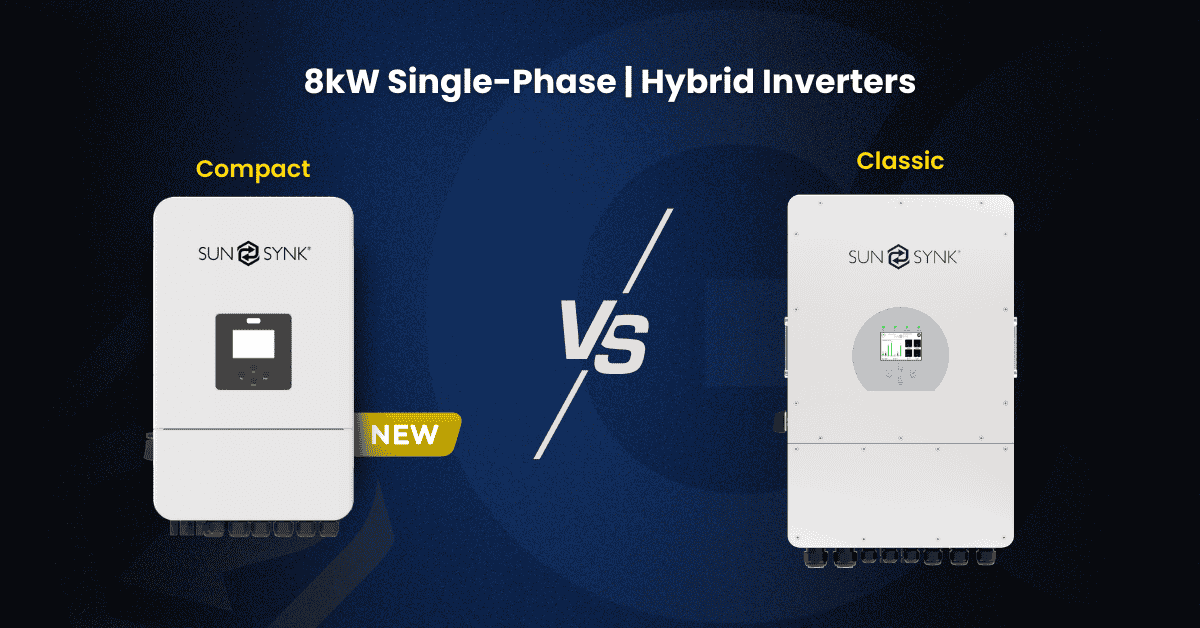
Models: SYNK-8K-SG05LP1-SM2 vs. SUNSYNK-8K-SG01LP1 / SUNSYNK-8K-SG02LP1
This document provides a technical comparison of two prominent 8kW single-phase hybrid inverters from Sunsynk. The analysis focuses on the key specification and feature differences between the SYNK-8K-SG05LP1-SM2, referred to as the ‘Compact’ model, and the SUNSYNK-8K-SG01LP1 / SUNSYNK-8K-SG02LP1, referred to as the ‘Classic’ model. The objective of this report is to deliver a data-driven analysis for technicians, system designers, and sales engineers. By clearly articulating the distinctions in performance, physical characteristics, and safety features, this comparison aims to inform system design decisions and guide appropriate product selection for specific project requirements.
Key Differentiators at a Glance
For efficient project scoping and client consultation, a high-level understanding of the primary differences between these two models is essential. While both inverters share the same core 8kW power rating and foundational Sunsynk technology, their design philosophies diverge in key areas affecting array design, installation logistics, and safety. The following table provides a rapid assessment of the most significant differentiators.
High-Level Feature Comparison
| Feature | SYNK-8K-SG05LP1-SM2 (Compact) | SUNSYNK-8K-SG01LP1 / SG02LP1 (Classic) |
| Maximum PV Power (Manufacturer Term) | 16000W (Max. PV Access Power) | 10400W (Max. DC Input Power) |
| Max. PV Input Power | 12800W | 10400W |
| Euro Efficiency | 96.50% | 97.00% |
| Net Weight | 26.8kg | 32kg |
| Cabinet Size (WxHxD) | 366 x 589.5 x 237 mm | 420 x 670 x 233 mm |
| Key Protection Feature Difference | PV Arc Fault Detection is not listed | PV Arc Fault Detection |
This summary highlights that the Compact model is tailored for larger solar arrays and easier physical installation, while the Classic model offers higher operational efficiency and a safety feature set. The subsequent sections will provide a more granular analysis, beginning with the critical solar power input capabilities.
PV String Input Specifications
The performance of a solar energy system is fundamentally defined by its ability to interface with the PV array. The inverter’s PV input stage determines the flexibility in array sizing, string configuration, and overall energy harvesting potential. This section dissects the solar array interface specifications for each model to clarify their design capabilities.
| Specification | SYNK-8K-SG05LP1-SM2 (Compact) | SUNSYNK-8K-SG01LP1 / SG02LP1 (Classic) |
| Max. PV Access Power | 16000W | Not listed |
| Max. PV Input Power | 12800W | 10400W (as Max. DC Input Power) |
| Max. PV Input Voltage | 500V | 500V |
| Start-up Voltage | 125V | 125V |
| PV Input Voltage Range | 125-500V | 125V~500V |
| MPPT Voltage Range | 150-425V | 150~425V |
| Full Load MPPT Voltage Range | 200-425V | Not listed |
| Rated PV Input Voltage | 370V | 370V |
| Max. Operating PV Input Current | 32A+32A | 26Ad.c + 26Ad.c |
| Max. Input Short-Circuit Current | 48A+48A | 44Ad.c + 44Ad.c |
| No. of MPP Trackers / Strings per Tracker | 2 / 2+2 | 2 / 2+2 |
Analysis of PV Input Capabilities
The most significant distinction lies in the PV power handling capacity. The Compact model’s “Max. PV Access Power” of 16000W and “Max. PV Input Power” of 12800W is substantially higher than the Classic model’s 10400W limit. This allows the Compact model to be paired with a DC array that is up to 200% of its rated AC output (16000W / 8000W), a significant increase over the Classic model’s 130% oversizing ratio (10400W / 8000W). This gives the Compact model a decisive advantage in system designs that employ PV array “oversizing” to maximise energy harvesting during periods of lower solar irradiance and to compensate for long-term panel degradation. The Compact model also supports a higher operating input current per MPPT (32A vs. 26Ad.c), accommodating higher-current solar modules.
This superior PV input flexibility positions the Compact model as the preferred choice for maximising solar generation. We will now shift our focus from power generation to the critical functions of energy storage and AC power delivery.
Analysis of Battery and AC Performance Metrics
An effective hybrid inverter must not only convert DC solar power but also expertly manage battery storage and interact seamlessly with the AC grid or local loads. This section evaluates the battery interface and AC output characteristics to determine each model’s proficiency in ensuring energy security and grid interaction efficiency.
Battery Input Data
| Parameter | SYNK-8K-SG05LP1-SM2 (Compact) | SUNSYNK-8K-SG01LP1 / SG02LP1 (Classic) |
| Battery Type | Lead-acid or Li-Ion | Lead-acid or Li-Ion |
| Battery Voltage Range | 48Vd.c (40Vd.c ~ 60Vd.c) | 48Vd.c (40Vd.c ~ 60Vd.c) |
| Max. Charging/Discharging Current | 190Ad.c (max.) | 190Ad.c (max.) |
| Charging Strategy for Li-Ion | Self-adaption to BMS | Self-adaption to BMS |
| Charging Curve | Not mentioned | 3 Stages / Equalization |
| External Temperature Sensor | Not mentioned | Yes |
AC Input/Output Data
| Parameter | SYNK-8K-SG05LP1-SM2 (Compact) | SUNSYNK-8K-SG01LP1 / SG02LP1 (Classic) |
| Rated AC Input/Output Active Power | 8000W | 8000W |
| Max. AC Power | 8800VA | 8800W |
| Peak Power (off-grid) | 2 times of rated power, 10s | 2 times of rated power, 10s |
| Max. Continuous AC Passthrough | 50A | 50A |
| Max. AC Input/Output Current | 40/38.3A | 38.3A (Max.) / 34.8A (Rated) |
Efficiency
| Parameter | SYNK-8K-SG05LP1-SM2 (Compact) | SUNSYNK-8K-SG01LP1 / SG02LP1 (Classic) |
| Max. Efficiency | 97.60% | 97.60% |
| Euro Efficiency | 96.50% | 97.00% |
| MPPT Efficiency | >99% | >99% |
Assessment of Performance Metrics
While both inverters deliver a rated 8000W of active power, a critical distinction exists in their maximum AC power rating. The Compact model is rated at 8800VA (apparent power), while the Classic is rated at 8800W (real power). For loads with a power factor less than unity, the 8800VA rating provides greater headroom to supply both real and reactive power, a key consideration for systems with inductive loads like motors.
In terms of conversion efficiency, the Classic model’s Euro Efficiency of 97.00% is higher than the Compact’s 96.50%. As Euro Efficiency is a weighted value reflecting performance across various power levels, this suggests the Classic model may yield slightly more energy over time.
For battery management, the Classic model offers a more sophisticated feature set. The inclusion of an External Temperature Sensor allows for superior temperature-compensated charging, which is critical for optimising battery health and safety. Furthermore, its specified Equalisation charging capability is an essential maintenance cycle for certain lead-acid batteries, designed to prevent sulfation and extend operational lifespan.
Having reviewed the internal performance characteristics, we now turn to the external physical attributes that directly impact the installation process.
Physical Characteristics and Installation Considerations
Beyond electrical specifications, the physical dimensions, weight, and environmental ratings of an inverter are critical logistical factors for installation planning. These attributes determine site suitability, mounting requirements, and the level of effort required by technicians.
Visually, the two units are distinct. The Classic model features a larger chassis with a more advanced graphical colour LCD, providing a detailed visual overview of system status. The Compact model, true to its name, utilises a smaller chassis and a simpler, more functional LCD with LED status indicators.
Physical and Environmental Specifications
| Attribute | SYNK-8K-SG05LP1-SM2 (Compact) | SUNSYNK-8K-SG01LP1 / SG02LP1 (Classic) |
| Cabinet Size (WxHxD) | 366 x 589.5 x 237 mm | 420W×670H×233D |
| Weight | 26.8kg | 32kg (Net Weight) |
| Ingress Protection (IP) Rating | IP65 | IP65 |
| Type of Cooling | Smart cooling | Smart cooling |
| Noise | <30 dB | <30 dB |
| Operating Temperature Range | -40~60 ºC, >45 ºC Derating | -40~60 ºC, >45 ºC Derating |
Impact on Installation
The physical differences have significant practical implications. The Compact model is considerably lighter at 26.8 kg compared to the Classic’s 32 kg, a reduction of over 5 kg. It also has a noticeably smaller footprint. This combination of lower weight and reduced size makes the Compact model a more suitable choice for installations where space is at a premium or where wall load-bearing capacity is a concern. For the installing technician, the lighter weight can simplify the mounting process, potentially reducing installation time and labour requirements. Both units share the same robust IP65 rating, making them suitable for a wide range of installation environments.
With the physical installation factors considered, the final piece of the analysis is the system’s safety framework and communication interfaces.
Comparison of Protection, Standards, and Interfaces
Integrated protection features and robust communication capabilities are paramount for ensuring system safety, regulatory compliance, and remote monitoring performance. This section compares these vital subsystems.
Integrated Protection
SYNK-8K-SG05LP1-SM2 (Compact)
- PV Input Lightning Protection
- Anti-islanding Protection
- PV String Input Reverse Polarity Protection
- Insulation Resistor Detection
- Residual Current Monitoring Unit
- Output Over Current Protection
- Output Shorted Protection
SUNSYNK-8K-SG01LP1 / SG02LP1 (Classic)
- PV Arc Fault Detection
- PV Input Lightning Protection
- Anti-islanding Protection
- PV String Input Reverse Polarity Protection
- Insulation Resistor Detection
- Residual Current Monitoring Unit
- Output Over Current Protection
- Output Shorted Protection
Analysis of Protection Features
The most critical difference in the safety suite is the inclusion of PV Arc Fault Detection in the Classic model. This is a significant safety feature designed to detect and interrupt dangerous electrical arcs on the DC side of the system, which are a potential fire hazard. The absence of this feature in the Compact model’s specification list positions the Classic model as the superior choice for installations where the highest level of safety is a primary requirement or mandated by local regulations.
Communication and Interface
| Interface Type | SYNK-8K-SG05LP1-SM2 (Compact) | SUNSYNK-8K-SG01LP1 / SG02LP1 (Classic) |
| Display | LCD+LED | Graphical Colour Display |
| Communication Interface | RS232, RS485, CAN | RS485; CAN |
These differences in protection and interface will directly influence the final selection based on your project priorities, which we will summarise in the conclusion.
Application Suitability and Selection Guide
Both the Sunsynk ‘Compact’ and ‘Classic’ 8kW models are highly capable hybrid inverters, but this analysis reveals that they are engineered with different application priorities in mind. The choice between them is not a matter of which is “better” overall, but which is better suited to the specific demands of a given project. Their distinct strengths in PV input capacity, physical design, efficiency, and safety features make them ideal for different scenarios.
Ideal Scenarios for SYNK-8K-SG05LP1-SM2 (Compact)
- Systems requiring a large, oversized PV array: Its 16000W access power provides unmatched flexibility for maximising energy harvest, especially in regions with variable solar irradiance.
- Installations with space or weight constraints: Its significantly lighter weight and smaller physical footprint make it the clear choice for sites with limited wall space or where structural load-bearing capacity is a concern.
- Projects prioritising installation efficiency: The lower physical weight simplifies logistics, handling, and mounting, potentially reducing installation time and labour costs.
Ideal Scenarios for SUNSYNK-8K-SG01LP1 / SG02LP1 (Classic)
- Installations where safety is paramount: The inclusion of PV Arc Fault Detection offers a critical layer of protection against DC-side electrical faults and potential fire hazards.
- Applications benefiting from slightly higher Euro Efficiency: Its superior Euro Efficiency suggests better overall performance across a typical day’s operating conditions, maximising the return on investment over the system’s lifetime.
- Systems with specific battery management needs: The explicit inclusion of an external battery temperature sensor and equalisation charging makes it better suited for optimising the health and lifespan of specific battery chemistries, particularly lead-acid types.
Register with us or log in to the Get Off Grid portal for our broad range of Sunsynk Inverters. Available at all our branches | Get Off Grid Randburg | Get Off Grid Centurion | Get Off Grid Cape Town | Get Off Grid Zambia
Like this article? Please share!
Disclaimer: The information provided in this article is intended for educational and informational purposes only. Every effort has been made to ensure accuracy. However, we advise that readers consult datasheets and installation manuals to verify information. For specific project requirements or additional guidance, please contact the Get Off Grid technical team.